When selecting a bag closing method for an industrial bakery, it is easy to focus only on the closure itself: how secure it is, what it costs, and whether consumers can reopen the bag.
However, the closing method can also have a major impact on how the entire packaging machine can be designed and how well the product can be controlled during packaging.
This is one of the main reasons why clipband closing has remained a highly successful solution for industrial bread and bakery packaging. It combines a simple, consumer-friendly closure with excellent reliability, low material cost and, importantly, the possibility to build a truly linear packaging process.

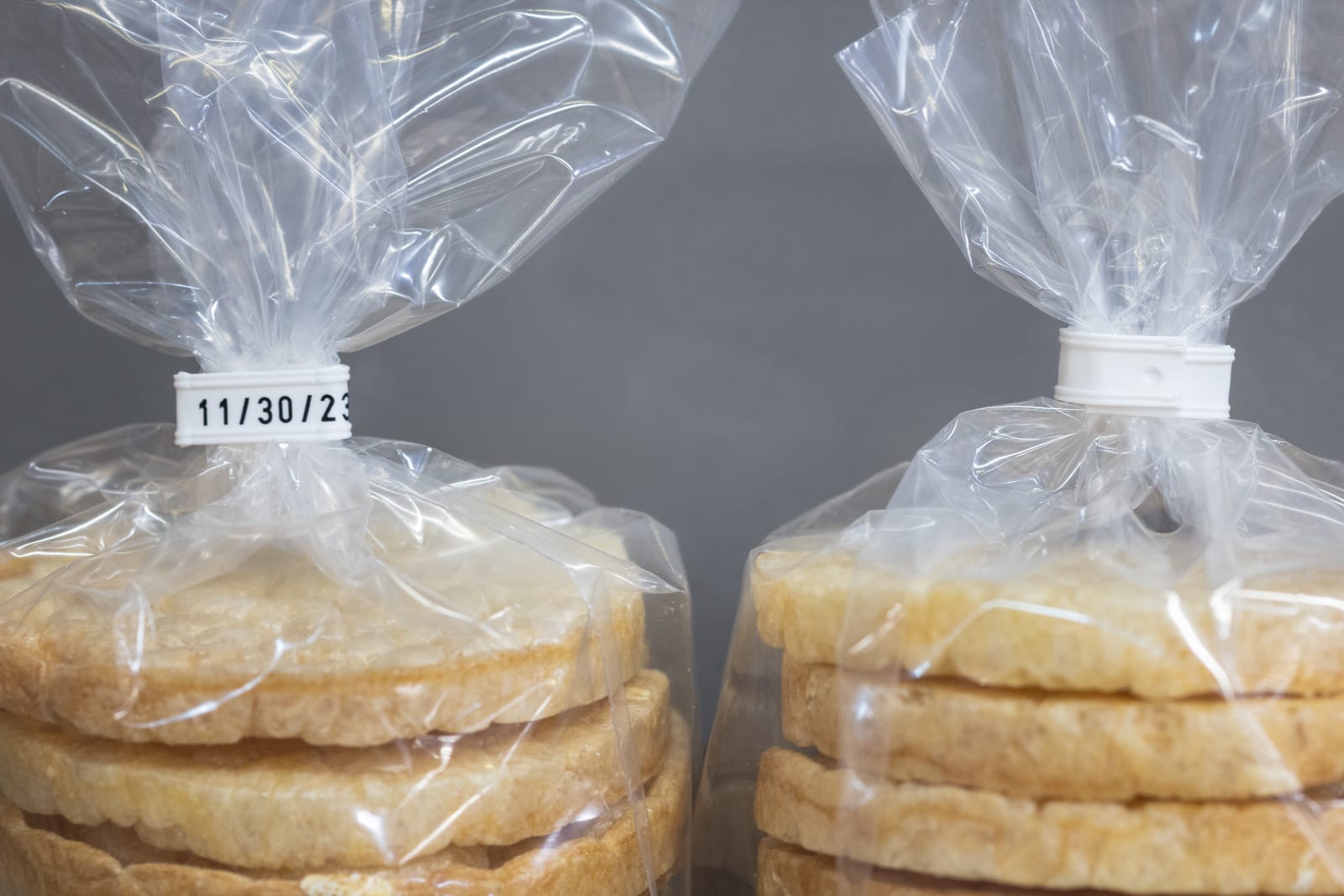
A clipband closure works essentially like a small clamp around the gathered neck of the bag.
In Ipeka packaging machines, the clipband material is first formed into a U-shaped piece. Before closing, the bag mouth is gathered from both the vertical and horizontal directions. The U-shaped clipband is then brought around the gathered bag neck and its sides are folded towards the center, creating a firm, staple-like closure.
This provides two important benefits: the closure sits firmly around the bag during transportation and handling, while the consumer can still easily open it and use it again to reclose the package.
Clipband closing can also be used with suitable paper bags as well as conventional plastic bags, giving bakeries more flexibility when choosing packaging materials.
One of the most important advantages of clipband is less obvious to the consumer but extremely important in industrial packaging.
Clipband closing allows the complete packaging process to remain linear.
The product enters the bag, and the bag can continue travelling in the same direction through the closing process. There is no need to transfer the bag sideways at a 90-degree angle with the wide side leading just to perform the closing operation.
This principle is used in both the Ipeka CL-35 bagger and the Ipeka Loafmaster fully automatic bagging machine. The product is inserted into the bag, after which the package continues forward to the closing operation.
For an industrial bakery, a linear process can also simplify the complete line layout. Slicing, bagging, closing and downstream conveyors can be arranged around a natural forward product flow instead of designing the line around a sideways movement required by the bag closer.
The advantage of linear packaging goes considerably further than simplifying the line layout.
It allows the packaging machine to maintain better control of the bag throughout the packaging cycle.
After the product has entered the bag, unnecessary changes in direction can make both the product and the loose bag increasingly difficult to control. With a linear clipband process, the machine can continue guiding the package while gathering the bag mouth and preparing it for closing.
This becomes particularly important when moving beyond standard rectangular toast bread.
Round bread, free-baked bread, sliced half loaves, soft products and other irregular bakery products can be considerably more difficult to handle automatically. Maintaining control of the bag until the closure has been completed helps make reliable automatic packaging possible for a wider range of products.

In industrial production, the reliability of the bag closing mechanism is extremely important. A problem at the closing station can interrupt the entire packaging line.
Ipeka clipband closing mechanisms are designed specifically for continuous industrial operation and high production volumes. The principle has been used in Ipeka packaging equipment for decades.
The Ipeka CL-35 is a good example. More than one thousand CL-35 machines have been delivered to bakeries around the world, and the machine is capable of production rates of approximately 35-38 bags per minute with a trained operator.
For a high-volume bakery, this kind of proven reliability can be more important than small differences in individual machine specifications. Clipband is particularly well suited to applications where the objective is to keep production running without constantly adjusting, repairing or rebuilding the bag closing equipment.
Clipband is widely used for bakery packaging in many parts of the world. The material is produced by more than ten manufacturers in different regions, with particularly strong availability in Europe.
This established supply base and large production volume make clipband a remarkably economical packaging material.
The cost per closure can be only a fraction of the cost of some alternative bag closing systems. The difference may appear small when calculated for a single package, but industrial bakeries should consider closure costs over millions or tens of millions of packages.
At that scale, even a small difference in cost per package can become a substantial annual operating expense.
There is one important consideration when using conventional clipband.
Traditional clipband contains metal wire. The same basic issue applies to metal-containing twistband closures commonly used in North America.
Consequently, a finished package closed with conventional clipband cannot normally pass through a traditional metal detector as the final inspection point, because the detector would react to the metal intentionally present in the closure.
This does not, however, mean that a bakery using clipband has to compromise its foreign-object inspection strategy. There are three practical solutions.
The simplest solution is to inspect the product with a conventional metal detector before it is packaged and clipband closed.
For production lines where metal detection provides the required level of inspection, this remains a straightforward and economical solution.
A more advanced alternative is to inspect the finished package using X-ray technology.
Unlike a conventional metal detector, an X-ray inspection system can be used with packaging containing a metal clip. In addition to metal, X-ray systems can detect several other types of dense foreign objects, such as glass, stones, bones and certain dense plastics.
Modern X-ray inspection can also provide capabilities beyond foreign-object detection. Depending on the equipment and application, the system can perform additional product and package quality checks, while AI-based image analysis is opening further possibilities for automated inspection.
Pack-by-pack inspection records can also be created. For example, an X-ray image of each package can be stored together with production information and linked to the identification code on the package. This provides additional possibilities for quality control and traceability.
X-ray inspection systems have also become increasingly accessible to food manufacturers. Companies such as Mekitec specialize in compact X-ray inspection systems designed specifically for the food industry.
For bakeries that want the advantages of clipband without metal in the closure, Ipeka also offers the Loafmaster Ultra.
Loafmaster Ultra uses Clipband Metal-Free from Schutte Bagclosures. Instead of the metal wire used in conventional clipband, the closure is secured using ultrasonic spot welding.
This allows the basic clipband closing principle and linear packaging process to be retained while providing a metal-free alternative for applications where this is required.

Clipband combines several practical advantages: a firm and reclosable closure, low material cost, high reliability and suitability for both plastic and appropriate paper bags.
For industrial packaging, its ability to support a linear packaging process is particularly important. Keeping the bag moving in the same direction makes it easier to maintain control of both the bag and the product until the package is closed, an advantage that becomes increasingly important with more challenging bakery products.
The metal in conventional clipband needs to be considered when planning product inspection. This can be addressed by using metal detection before packaging, X-ray inspection after packaging, or Clipband Metal-Free with the Ipeka Loafmaster Ultra.
Overall, clipband remains a simple, reliable and economical solution for industrial bakery packaging.
Clipband provides a firm but easily reclosable closure, low material costs and excellent reliability in high-capacity production. An important advantage for industrial bakeries is that clipband enables linear packaging: the bag can continue in the same direction from product insertion through closing. This allows better control of the bag and product throughout the packaging process and is particularly useful when packaging products that are more difficult to handle than standard toast bread.
Yes. Clipband closing can be used with suitable paper bags as well as plastic bags. Because the clipband forms a clamp around the gathered bag neck, the closing principle does not depend on heat-sealing the bag material itself. This gives bakeries more flexibility when selecting packaging materials while retaining the advantages of a reclosable closure and linear packaging process.
Clipband is one of the most economical bag closing methods available for industrial bakery packaging. The cost per closure is very low and can be only a fraction of the cost of some alternative closing methods, which becomes particularly important when producing millions of packages per year. Availability is also excellent. Clipband is a widely used closing method, and the material is manufactured by multiple suppliers in different parts of the world. This provides bakeries with a reliable supply of competitively priced closing material without depending on a single manufacturer.
Yes. Clipband is particularly well suited for best-before date coding, as the information is printed directly on the closure and remains easy for the consumer to find. A hot-stamp printer provides a simple and clear solution for printing the best-before date directly onto the clipband. When more information is required, an industrial inkjet printer can print two lines of information, allowing the closure to include details such as the production date, best-before date and batch number. This makes the clipband both a practical bag closure and a convenient location for essential product traceability information.
This article is based on Ipeka's knowledge base, built up over years of hands-on engineering experience. Every article is reviewed and edited by Ipeka's own experts. Claude (Anthropic) was used to help produce clear, high-quality English text.
