When manual bread packaging can no longer keep pace with production, moving to fully automatic packaging may seem like the obvious next step. But full automation is not necessarily the best solution for every bakery – and in some cases it may not be the right objective at all.
Semi-automatic packaging can achieve surprisingly high production rates while retaining the flexibility of human operators. Full automation becomes most attractive when products are dimensionally consistent, production batches are long enough, operating hours are high and the labor savings justify the additional investment.
The decision therefore depends mainly on five factors: product characteristics, batch sizes and changeover frequency, required capacity, labor availability and investment economics.
The first question is whether the product itself can be handled reliably by a fully automatic packaging system.
For bakeries producing mainly tin or pan bread, this is usually relatively straightforward. Baking tins control the length and width of the loaf, so product dimensions remain reasonably consistent. This makes tin bread particularly well suited for automatic slicing and packaging.
With free-baked bread, the situation can be very different. Without a baking tin controlling the dimensions, natural variation can be considerably greater. One loaf might be 290 mm long, the next 320 mm and another 300 mm.
For an operator inserting sliced bread into a bag, this variation is rarely a problem. Human hands automatically adapt to differences in size and shape.
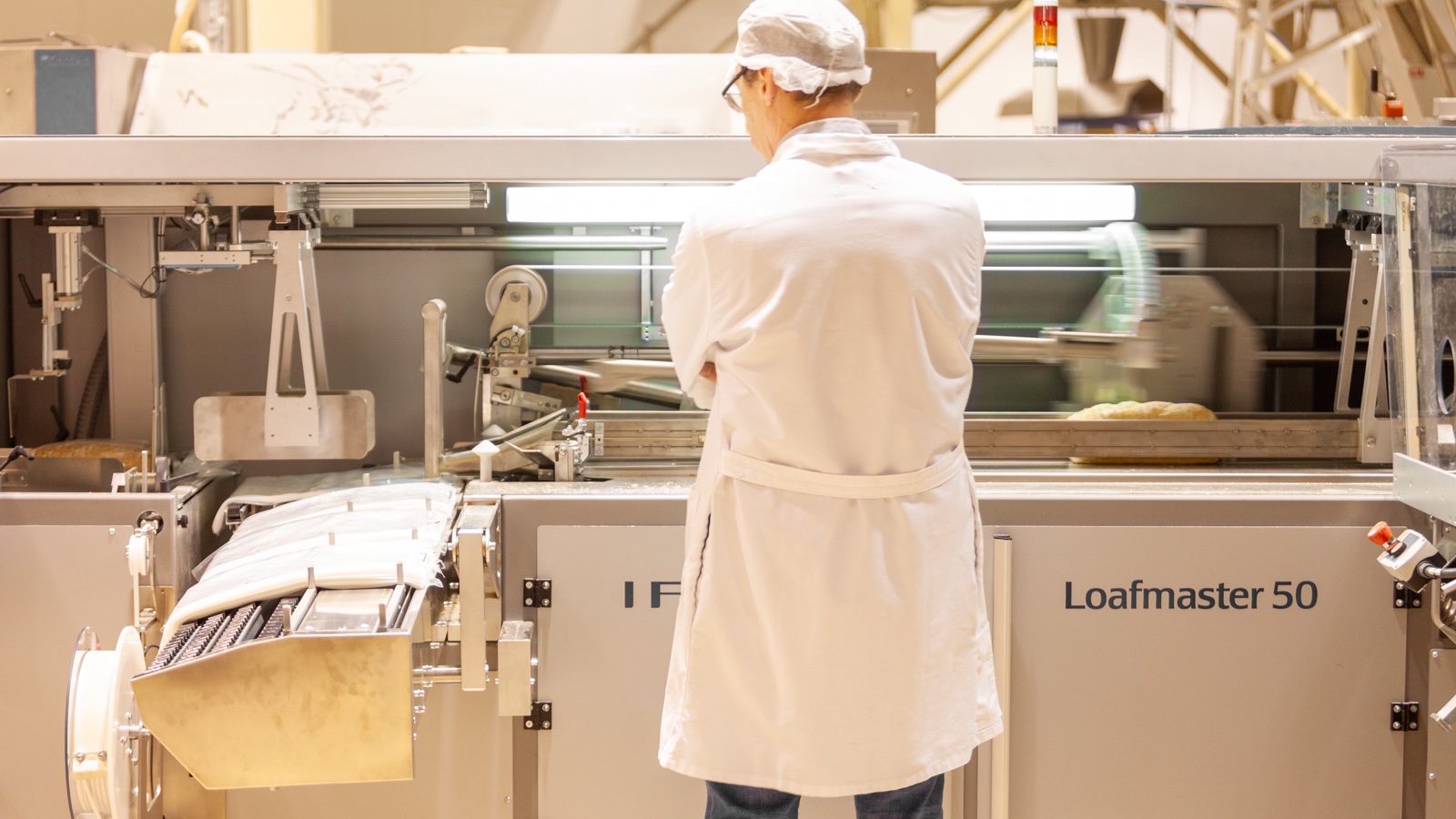
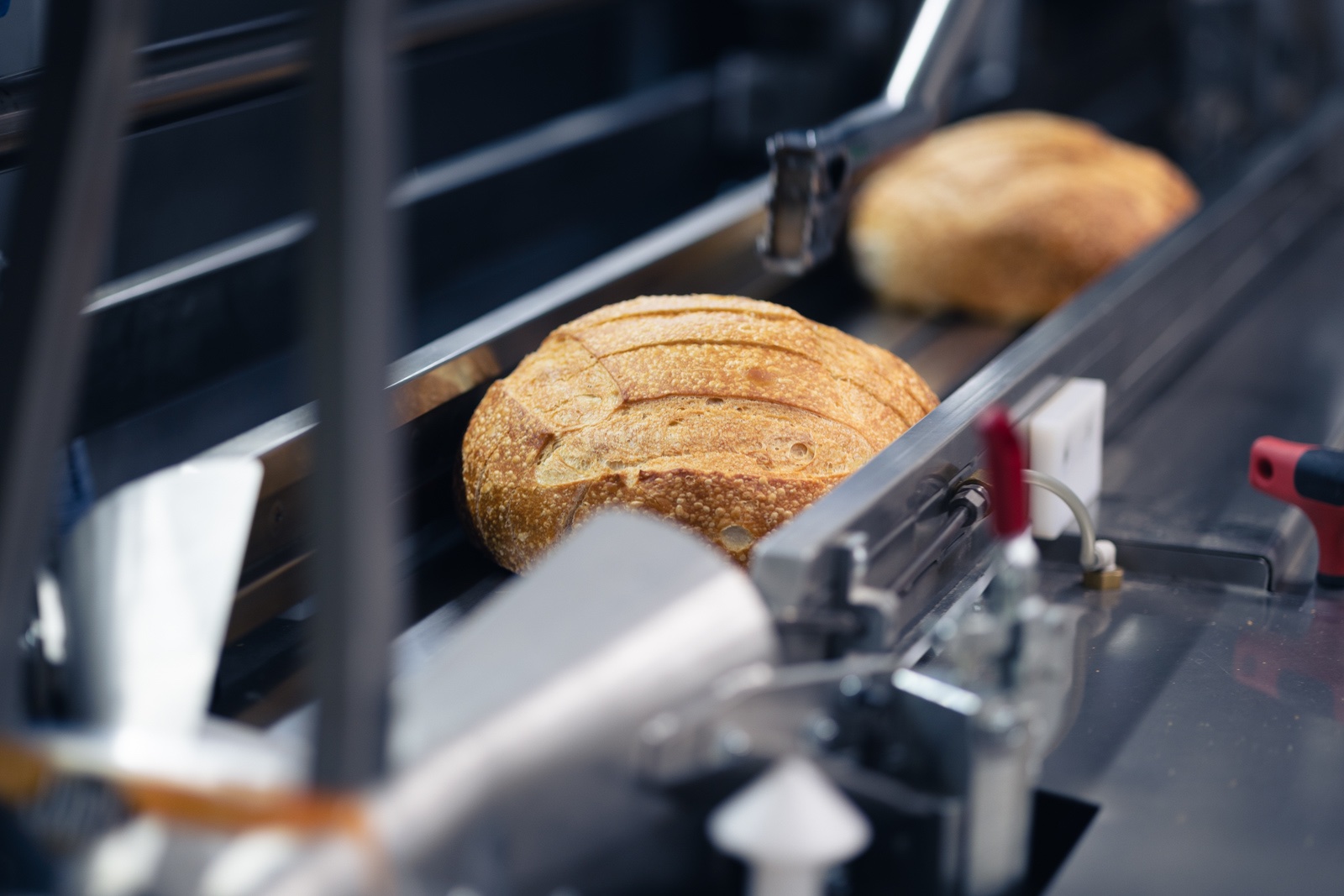
A fully automatic system cannot adapt in the same way. After slicing, the loaf must remain supported while it is transferred from the slicer into the bag. In an Ipeka Loafmaster line, side guides support the end slices during this transfer, and these guides are adjusted according to the bread length.
For free-baked products, Ipeka normally recommends keeping bread length variation within approximately ±8 mm for reliable automatic handling. If the variation is considerably greater, improving dimensional control or choosing semi-automatic packaging may be a better solution.
This is an important distinction: product variety and product variation are not the same thing.
A bakery can produce many different products on an automatic line as long as each product has sufficiently controlled dimensions. A bakery producing naturally variable free-baked products may face a much greater automation challenge even with a smaller product range.
Product variation is not always a production problem that should be eliminated.
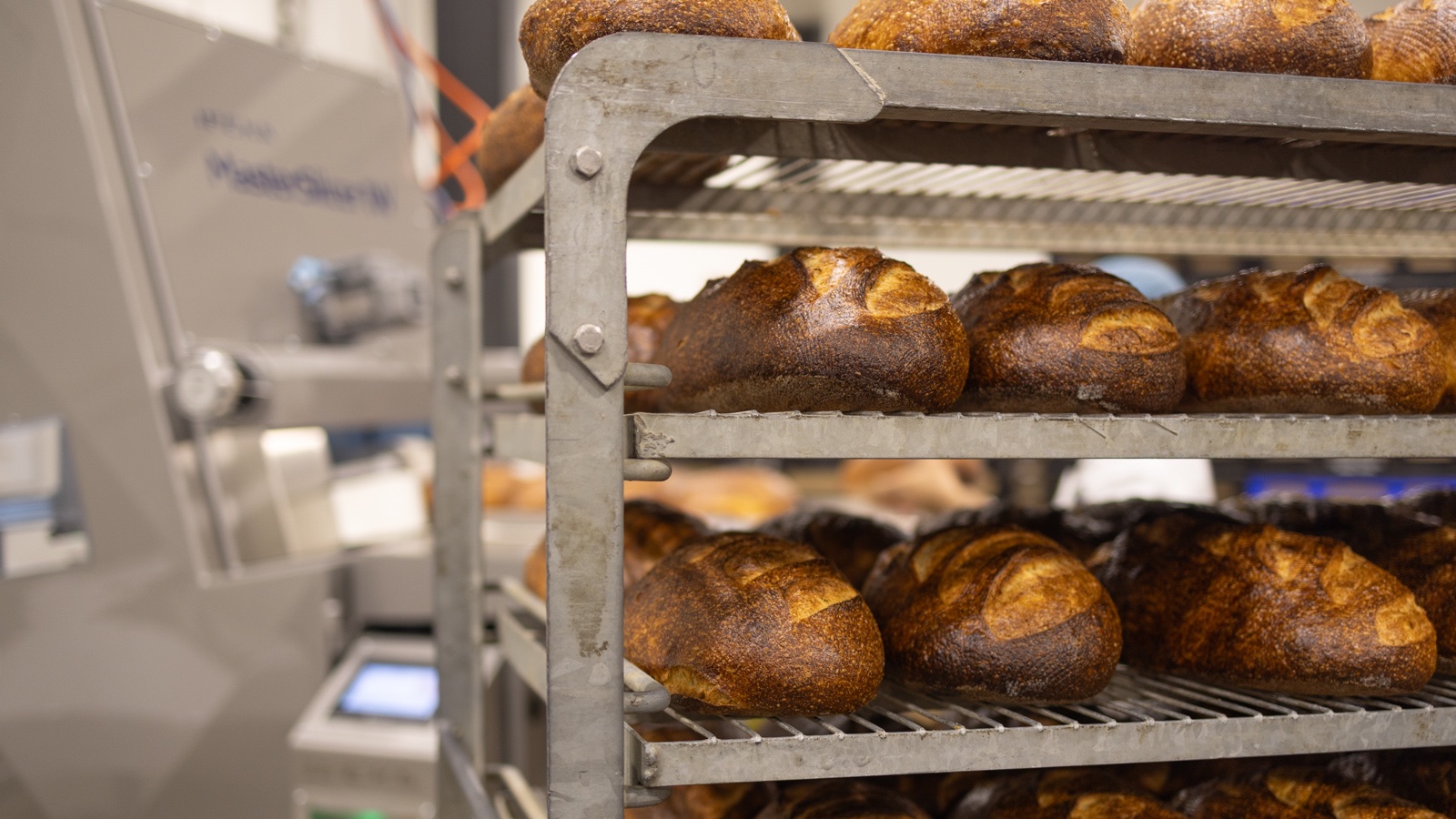
For some artisan and free-baked breads, a rustic, handmade appearance is one of the product's main selling points. Consumers may expect individual loaves to differ in length, shape and appearance. Trying to standardize these products simply to make them suitable for fully automatic packaging could remove some of the characteristics that make them attractive in the first place.
If natural variation and a homemade appearance are an important part of the product identity, fully automatic packaging may simply be the wrong objective.
A semi-automatic solution allows the bakery to increase packaging capacity and reduce repetitive manual work while retaining the flexibility needed to handle individual products.
Even when every product is dimensionally consistent, another factor can determine whether full automation makes practical sense: how long do you actually run each product size?
A fully automatic packaging line needs adjustments when changing from one bread size to another. If a bakery produces many small batches of different-sized products every day, a significant amount of available production time can be spent changing machine settings rather than packaging bread.
In an extreme case, adjusting the line for the next product size may take almost as much time as actually running that product.
Semi-automatic systems are much more flexible in this respect. Because operators perform the actual bag insertion, changing between product sizes generally requires fewer adjustments and can be considerably faster.
As a practical rule of thumb, we recommend having at least around 1,000 packages of the same product size per production run when considering fully automatic packaging.
At typical automatic packaging speeds, this represents approximately half an hour of continuous production. The 1,000-package figure is not a technical minimum, but smaller batches make it increasingly difficult to use a fully automatic line efficiently.
Different products do not necessarily require different machine settings.
A white toast bread, wholegrain bread and seeded bread may be completely different products commercially, but if their external dimensions are the same, they can potentially be packaged consecutively without changing the mechanical size settings.
Production should therefore be planned so that products with the same dimensions are grouped together whenever possible.
Instead of:
Size A → Size B → Size A → Size C → Size B
a more efficient schedule would be:
Size A → Size A → Size B → Size B → Size C
For a fully automatic packaging line, good production scheduling is an important part of achieving high efficiency. The objective is to maximize the production time with each machine setting before changing to the next product size.
It is easy to assume that the main reason for automatic packaging is higher production speed. With sliced bread, this is not necessarily the case.
An Ipeka Packmaster semi-automatic packaging line with two experienced operators can typically achieve approximately 30–40 bags per minute, depending on the product.
With Packmaster, airflow opens the bag, the operator inserts the sliced loaf, and the machine transports it to the bag closing unit. Human operators provide the flexibility while the equipment handles the repetitive mechanical operations.
For simpler applications, the CL-35 provides manual bag insertion combined with automatic clipband closing. With an experienced operator, production rates of up to approximately 30 bags per minute can be possible, depending on the product and working conditions.
A fully automatic Loafmaster line typically operates at around 35–40 bags per minute, depending on product dimensions, bag characteristics and line configuration.
The capacity difference between semi-automatic and fully automatic packaging can therefore be surprisingly small.
The main advantage of full automation is often not more bags per minute, but fewer labor hours per thousand packaged loaves.
Consider a bakery packaging 35 loaves per minute. That represents approximately 2,100 packaged loaves every hour.
If the line operates for only two hours per day, using operators for packaging may remain the most economical and flexible solution.
If the same line operates 16 hours per day, six days per week, the calculation is completely different.
This is why bags per minute alone tell you very little about whether automation is financially justified. The number of operating hours per year is at least as important.
The relevant questions are how many operators are required for packaging, how many hours they work each year and what that labor actually costs.
Labor availability can also be more important than salary. In some markets, the biggest challenge is finding and retaining enough people for repetitive packaging work. Automation may solve a production constraint even when the benefit cannot be measured simply in labor cost per hour.
Future growth should also be considered. If increasing production with a semi-automatic process would require additional operators on every shift, full automation may become attractive before the existing equipment has reached its maximum capacity.
Fully automatic packaging should not be considered as an isolated machine decision. In some bakeries, achieving reliable packaging automation may require looking at the entire bread production process – not only what happens after cooling.
An automatic packaging system needs to receive a product with sufficiently consistent dimensions and shape. If the bread varies too much, the solution may not be additional adjustments or more sophisticated handling at the packaging line. The variation may need to be reduced much earlier in the process.
This can mean reviewing production all the way from dough preparation, dividing and moulding to proofing, baking and cooling. Dough consistency, scaling accuracy, proofing conditions, baking tins and the baking process can all influence the dimensions and shape of the final loaf.
For an existing bakery producing bread with significant natural variation, moving to fully automatic packaging may therefore require much more than purchasing an automatic bagger. In some cases, the production process itself needs to be reorganized so that it consistently produces bread suitable for automatic handling.
This is particularly important when planning a new high-capacity bakery or production line. If fully automatic packaging is the final objective, its requirements should already be considered when designing the upstream production. It is much easier to produce bread suitable for automation from the beginning than to compensate for excessive variation at the end of the line.
The same whole-line thinking applies to capacity and product flow. Suppose your Masterslicer can slice 70 loaves per minute but the downstream packaging system handles 40. The complete line is still limited to approximately 40 packaged loaves per minute.
Bread also needs to arrive at the slicer in the correct orientation and with a sufficiently controlled flow. Depending on the cooling system and bakery layout, accumulation or product orientation equipment may be required before slicing.
For bakeries considering full automation, the most important question may therefore be broader than “Which packaging machine should we buy?”
It may be:
“Is our complete production process designed to produce bread that can be packaged automatically and reliably?”
A fully automatic line represents a significantly larger investment than a semi-automatic solution. The correct comparison is therefore not simply the purchase price of the two alternatives.
The more useful question is:
How much does the additional automation save each year?
As a simple example, suppose moving from semi-automatic to fully automatic packaging requires an additional investment of EUR 100,000.
If the automatic system creates EUR 20,000 in realistic annual savings, the simple payback on the additional investment is five years. If annual savings are EUR 50,000, the payback is two years.
The calculation should use the bakery's actual labor costs, yearly operating hours and realistic staffing requirements.
It should also consider future costs that automation may avoid. If production growth would otherwise require additional operators, overtime or another shift, these can be important parts of the investment calculation.
There is no production speed at which every bakery should automatically move from semi-automatic to fully automatic packaging.
For bakeries producing dimensionally consistent products in reasonably large batches, particularly tin or pan bread, full automation can be a natural next step. Long operating hours and high labor requirements make the case even stronger.
For bakeries producing many small batches, frequent size changes or free-baked products with significant natural variation, semi-automatic packaging can remain the more efficient solution – even at relatively high production speeds.
And if the rustic, handmade character and natural variation of the bread are important reasons why customers buy it, trying to redesign the product for full automation may be counterproductive. In that situation, semi-automation is often not a compromise but the right production solution.
As a practical starting point for fully automatic sliced bread packaging, we would look for:
Consistent product dimensions + approximately 1,000 or more packages per size per production run + sufficient yearly operating hours to justify the labor-saving investment.
The 1,000-package figure is a practical rule of thumb rather than a technical minimum. The longer the line can run without changing its size settings, the more efficiently the investment is being used.
Production planning can make a major difference as well. If several different breads have the same dimensions, running them consecutively can effectively turn several smaller product batches into one long packaging run.
Ultimately, the purpose of automation is not to automate as much as possible. It is to find the most efficient way to package the products your bakery actually produces.
For some bakeries, that means combining a Masterslicer with Packmaster or CL-35. For others, a fully automatic Masterslicer and Loafmaster line is the logical solution.
Contact Ipeka to discuss which level of sliced bread packaging automation best fits your products, production schedule and capacity requirements.
For Ipeka automatic packaging systems, we normally recommend keeping bread length variation within approximately ±8 mm for reliable automatic handling. The exact acceptable variation depends on the product and application. Tin or pan bread is normally easier to automate because the baking tins already control the product dimensions.
As a practical rule of thumb, we recommend approximately 1,000 packages or more per product size per production run. At typical automatic packaging speeds, this represents around half an hour of continuous production. This is not a technical minimum, but very short batches can result in too much production time being spent on machine adjustments.
The number of different recipes is less important than the number of different physical product sizes. Products with the same dimensions should ideally be scheduled consecutively so they can be packaged using the same machine settings. Good production planning can therefore significantly reduce changeover time on an automatic line.
Not necessarily. Packmaster with two experienced operators can typically achieve approximately 30–45 bags per minute, while Loafmaster normally operates at around 35–40 bags per minute, depending on the product and line configuration. Full automation is often more about reducing labor requirements than increasing maximum packaging speed.
There is no universal production volume or payback period. Operating hours, number of shifts, local labor costs, staffing requirements and future production growth all affect the calculation. A line running two or three shifts per day can justify automation much sooner than the same line operating only a few hours per day.
This article is based on Ipeka's knowledge base, built up over years of hands-on engineering experience. Every article is reviewed and edited by Ipeka's own experts. Claude (Anthropic) was used to help produce clear, high-quality English text.
