If your bakery already has a working bread slicer, the question of upgrading or adding another machine is not about replacing equipment for its own sake. It is about recognizing when your current slicer has become a constraint on production volume, product range, or operational flexibility.
Many bakeries outgrow their first slicer. Production volume increases. New product lines are added. Customer demand shifts toward denser breads, hard-crust artisan loaves, or gluten-free options. A slicer that performed well for white sandwich bread at moderate capacity may struggle when asked to handle dense rye at higher throughput or to switch between multiple slice thicknesses daily.
This article provides a decision framework rather than a sales pitch. The core question is practical: is your current slicer limiting your production, and if so, which specific problem needs to be solved?
Ipeka has manufactured Masterslicer bread slicers since 1990, representing over 35 years of experience in this product line. The range includes four models, each designed to solve different production problems: Masterslicer E for entry-level industrial capability, Masterslicer 1W for high-volume versatility, Masterslicer 1A for automatic slice thickness adjustment, and Masterslicer 2R for extra-heavy, dense, and hard-crust breads.
Several practical production situations indicate that your current slicer may have reached its operational limits:
Capacity bottleneck. Your slicer cannot keep pace with oven output or the packaging line. Bread queues up waiting to be sliced, creating a production constraint and delaying orders.
Product range expansion. You have added dense rye bread (especially over 50% rye content), hard-crust artisan loaves, or gluten-free breads to your product line, and the current slicer overloads, produces poor slice quality, or requires excessive blade maintenance when handling these products.
Need for multiple slice thicknesses. You offer several slice thickness options daily to meet customer demand (for example, 10 mm, 12 mm, 15 mm, or 18 mm slices), and manually adjusting slice thickness on your current machine interrupts production flow or creates setup delays.
Blade gumming and poor slice quality. Softer or stickier bread types cause blade buildup on your current machine, resulting in uneven slices, frequent stops for cleaning, or rejected product.
Bakeries often outgrow their first slicer as production volume or product variety increases beyond what the original machine was designed for. The decision to upgrade should be driven by a specific operational constraint, not by equipment age alone.
If your current slicer cannot keep up with production volume, the bottleneck is throughput. Bread accumulates before slicing, the packaging line waits, and the production schedule becomes compressed.
Masterslicer 1W is designed to solve this problem. It can handle up to 70 loaves per minute and is built for heavy industrial use. The machine is versatile enough for white and whole grain breads, making it suitable for bakeries that produce a range of standard products at high volume.
Masterslicer 1W is the most sold model in the Ipeka range. It features motorized blade tensioning, which supports consistent operation at high throughput by maintaining proper blade tension automatically as the machine runs.
The 1W also includes lateral infeed conveyors, which help significantly when running tin baked bread (loaves baked in pans) at high capacity, especially when the bread end is straight. These conveyors guide the loaf into the slicing band more reliably than side guides alone, reducing misalignment and rejected slices.
If your current slicer was originally selected for lower production volumes and your oven output has since increased, a mismatch in capacity creates a persistent bottleneck. In this scenario, upgrading to a machine designed for higher throughput addresses the root cause.
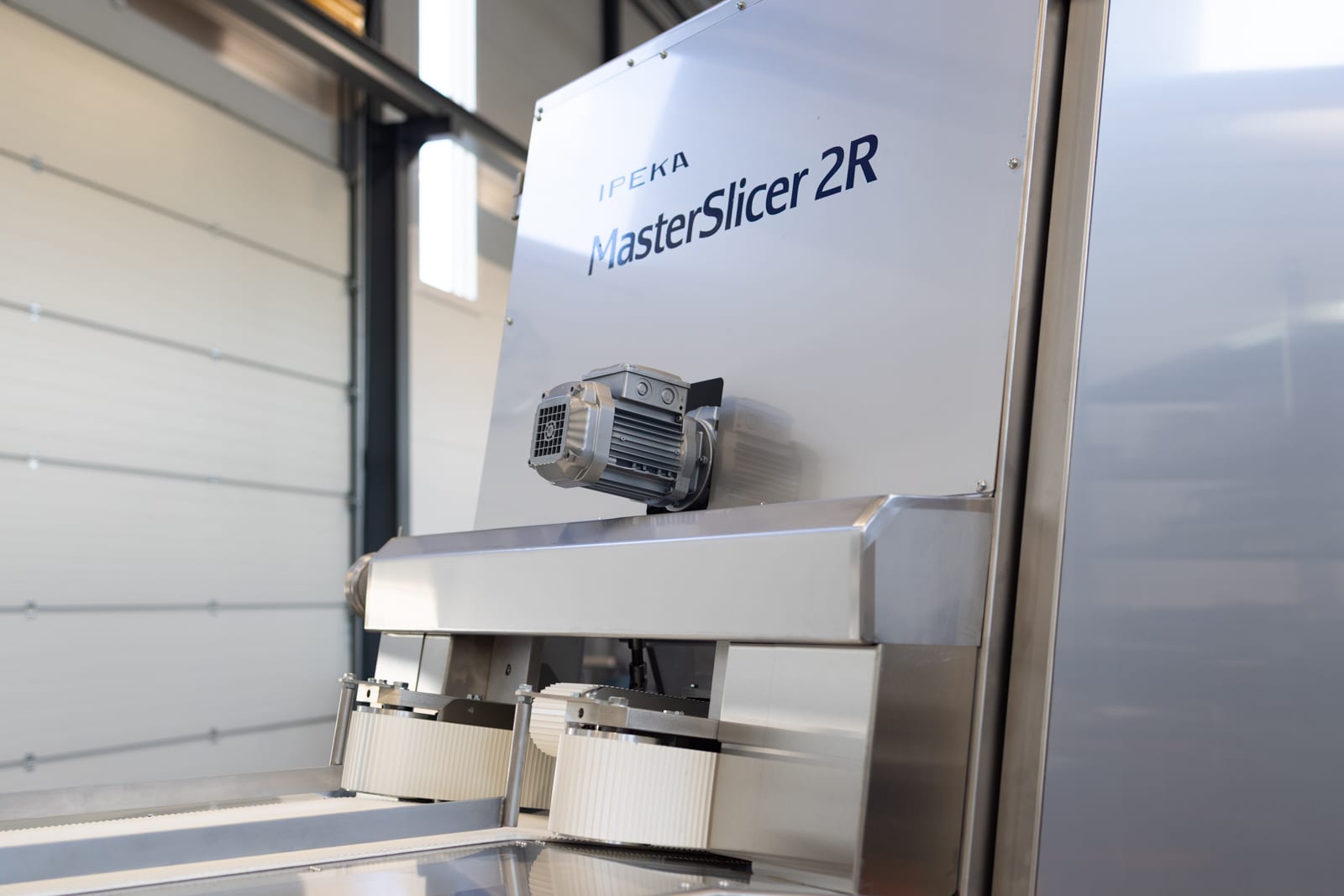
Adding new bread types to your product line can reveal capability limits in your current slicer. Dense rye bread, hard-crust artisan loaves, and gluten-free breads place greater mechanical load on the slicing band and motor than standard white or whole grain breads.
For dense rye bread with over 50% rye content (by grain), Ipeka recommends Masterslicer 2R. This model is equipped with a 7.5 kW motor and a 184-inch blade length, providing the power and blade surface area needed to slice extra-heavy, dense breads without overloading the drive system.
Masterslicer 2R is also specifically suitable for hard-crust artisan breads and large, heavy gluten-free loaves. Gluten-free bread can be particularly challenging to slice because it often lacks the structural cohesion of wheat-based breads and may crumble or compress if the slicer does not have sufficient power and blade support.
If your bread has a smaller proportion of rye but is still relatively soft, or if your gluten-free loaves are smaller and lighter, the 1W or E models can handle slicing if equipped with the optional blade oiling system. The decision depends on loaf size, density, and crust characteristics, not just bread type.
Attempting to slice dense or hard-crust breads on a machine designed for lighter products may result in motor overload, inconsistent slice quality, excessive blade wear, or frequent stoppages. In these cases, the 2R provides the mechanical capacity required for reliable operation.
Blade gumming is a common problem when slicing softer or stickier bread types. Bread residue builds up on the blade, reducing slice quality and requiring frequent stops to clean the band.
The blade oiling system addresses this problem by applying a controlled amount of oil to the blade during operation. This prevents bread from adhering to the band and enables smooth, continuous slicing of bread types that would otherwise cause buildup.
Blade oiling is standard on Masterslicer 2R. It is available as an option on Masterslicer 1W and Masterslicer E.
If your current slicer struggles with certain bread types due to blade buildup, adding blade oiling capability may solve the problem without necessarily upgrading to a higher-capacity model. For bakeries that produce a mix of standard and softer breads, the optional blade oiling system on the E or 1W models provides operational flexibility.
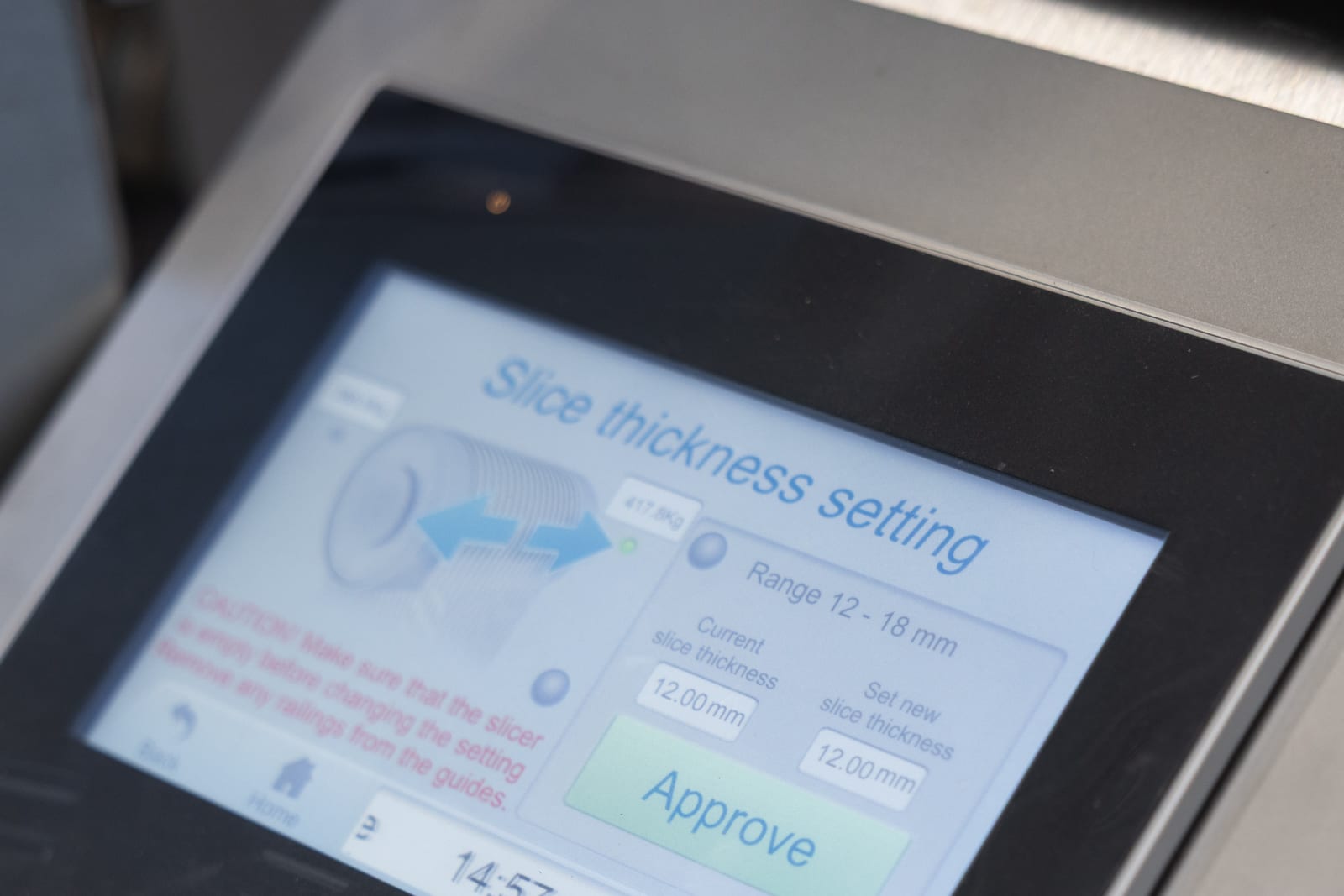
Bakeries that offer multiple slice thickness options to customers face a practical challenge: changing slice thickness on most slicers requires manual adjustment, which interrupts production and creates setup time between runs.
Masterslicer 1A solves this problem with automatic slice thickness adjustment. The machine can vary slice thickness within defined ranges, such as 10–15 mm, 11–16.5 mm, 12–18 mm, or 14–22 mm. Slice thickness is selected from the touch screen, and the adjustment is fully automatic, including load sensor controlled blade tensioning.
The load sensor controlled blade tensioning is significant because it automatically adjusts blade tension to match the selected slice thickness and the resistance encountered during slicing. This maintains consistent slice quality across different thicknesses and bread types without manual intervention.
Masterslicer 1A can handle bread loaves of all types and consistencies, making it suitable for bakeries that produce a diverse product range and need to change slice thickness frequently without production delays.
If your bakery changes slice thickness only occasionally, manual adjustment on other models may be sufficient. But if multiple thickness options are offered daily or if customer orders require frequent changeovers, the automatic adjustment in the 1A model eliminates a recurring production bottleneck.
Bakeries upgrading from semi-automatic or manual slicing face a different set of requirements. The priority is often to establish continuous production flow and reduce labor dependency, rather than to maximize throughput or handle specialized bread types.
Masterslicer E is designed as the entry point for industrial slicing. It features powered infeed and outfeed conveyors for continuous operation and a user-friendly touch screen interface. Motor power is now the same as on the 1W, and blade oiling is available as an option.
The operational differences between the E and higher models matter in specific contexts. Masterslicer E does not have lateral infeed conveyors. Instead, it uses side guides and a wider top conveyor to guide loaves into the slicing band. For most bread types and moderate production volumes, this arrangement works well. However, when running tin baked bread at high capacity, especially when the bread end is straight, lateral infeed conveyors (as found on the 1W) provide more reliable alignment and smoother feeding.
Blade tensioning on the E is done manually via a hand wheel at the upper drum, with the side door open. This is not motorized, unlike the 1W. For bakeries that run consistent bread types and do not change tension settings frequently, manual tensioning is perfectly adequate. But in operations where tension adjustments are made regularly, motorized tensioning reduces setup time.
For bakeries moving from manual or semi-automatic slicing, the E model provides powered conveyors, consistent slice quality, and the ability to integrate into a continuous production line. It is a practical step up without the additional features and cost associated with higher-capacity or specialized models.
The decision to upgrade or add a Masterslicer should begin by identifying the specific production constraint you need to solve.
If your bottleneck is speed: Your current slicer cannot keep pace with oven output or packaging line capacity. Consider Masterslicer 1W, which handles up to 70 loaves per minute and is designed for heavy industrial use. The motorized blade tensioning and lateral infeed conveyors support reliable operation at high throughput.
If your bottleneck is bread type capability: You have added dense rye bread (over 50% rye content), hard-crust artisan loaves, or large, heavy gluten-free breads, and your current slicer overloads or produces poor slice quality. Consider Masterslicer 2R, which is equipped with a 7.5 kW motor, 184-inch blade, and blade oiling system as standard. This model provides the mechanical capacity required for extra-heavy, dense, and hard-crust breads.
If your bottleneck is slice thickness flexibility: You offer multiple slice thicknesses daily, and manual adjustment interrupts production flow. Consider Masterslicer 1A, which provides automatic slice thickness adjustment in ranges such as 10–15 mm, 11–16.5 mm, 12–18 mm, or 14–22 mm, with fully automatic load sensor controlled blade tensioning. This eliminates setup delays and supports frequent changeovers.
If you are moving from manual or semi-automatic slicing: Your priority is continuous production flow and reduced labor dependency rather than maximum capacity or specialized capability. Consider Masterslicer E, which provides powered infeed and outfeed conveyors, touch screen interface, and optional blade oiling at an entry-level industrial price point.
Not every bakery needs higher capacity or specialized capability. Some operations are well served by their current equipment. Upgrading should be driven by a specific operational constraint, not by equipment age or replacement for its own sake.
The decision to upgrade or add an Ipeka Masterslicer should start with a clear understanding of your current production bottleneck. Is it speed, bread type capability, or the need for operational flexibility such as multiple slice thicknesses?
Ipeka offers four Masterslicer models, each designed to solve different problems. Masterslicer E provides entry-level industrial capability for bakeries moving from manual or semi-automatic slicing. Masterslicer 1W delivers high-volume throughput for heavy industrial use. Masterslicer 1A offers automatic slice thickness adjustment for bakeries that need operational flexibility. Masterslicer 2R handles extra-heavy, dense, hard-crust, and gluten-free breads that exceed the capability of standard slicers.
The right choice depends on the specific constraint your operation faces. A slicer that solves the wrong problem, or that adds capability you do not need, does not improve your production flow.
Review the full specifications and capabilities of each Masterslicer model on our product pages, or contact Ipeka to discuss which slicer configuration best addresses your current production bottleneck.
Consider upgrading when your current slicer creates a production bottleneck. Common scenarios include: the slicer cannot keep pace with oven output or packaging line (capacity limit), you have added dense rye, hard-crust, or gluten-free breads that overload the current machine (bread type capability limit), you need to offer multiple slice thicknesses daily and manual adjustment interrupts production (flexibility limit), or blade gumming on softer breads causes frequent stops (blade oiling needed). If your current slicer handles your production volume and product range without constraint, upgrading may not be necessary.
For dense rye bread with over 50% rye content or large, heavy gluten-free loaves, Ipeka recommends Masterslicer 2R. It is equipped with a 7.5 kW motor, 184-inch blade length, and blade oiling system as standard. If your rye bread has a smaller proportion of rye or your gluten-free loaves are smaller and lighter, Masterslicer 1W or E can handle slicing if equipped with the optional blade oiling system. The decision depends on loaf size, density, and crust characteristics.
The blade oiling system applies a controlled amount of oil to the blade during operation, preventing softer or stickier bread from adhering to the band and causing gumming. Blade oiling is standard on Masterslicer 2R and available as an option on Masterslicer 1W and Masterslicer E. If your current slicer struggles with blade buildup on certain bread types, adding blade oiling capability may solve the problem.
All Masterslicer models can be adjusted for different slice thicknesses. Masterslicer 1A offers automatic slice thickness adjustment within defined ranges such as 10–15 mm, 11–16.5 mm, 12–18 mm, or 14–22 mm. Slice thickness is selected from the touch screen, and adjustment is fully automatic with load sensor controlled blade tensioning. Other models (E, 1W, 2R) require manual adjustment, which is adequate for bakeries that change thickness infrequently but may interrupt production flow if changeovers are frequent.
Motor power is now the same on both models, and blade oiling is available as an option on both. The two main differences are: (1) Masterslicer E does not have lateral infeed conveyors (it uses side guides and a wider top conveyor instead), which matters mainly when running tin baked bread at high capacity, and (2) blade tensioning on the E is manual via hand wheel, while the 1W has motorized blade tensioning. Masterslicer 1W is designed for heavy industrial use and can handle up to 70 loaves per minute. Masterslicer E is an entry-level industrial slicer suitable for bakeries moving from manual or semi-automatic slicing.
Identify your current production bottleneck first. If the bottleneck is speed (slicer cannot keep pace with production), consider Masterslicer 1W (up to 70 loaves per minute). If the bottleneck is bread type capability (dense rye, hard-crust, or large gluten-free breads overload your current slicer), consider Masterslicer 2R. If the bottleneck is slice thickness flexibility (you offer multiple thicknesses daily), consider Masterslicer 1A with automatic adjustment. If you are upgrading from manual or semi-automatic slicing, consider Masterslicer E for entry-level industrial capability. Contact Ipeka to discuss your specific production constraints and product range.
This article is based on Ipeka's knowledge base, built up over years of hands-on engineering experience. Every article is reviewed and edited by Ipeka's own experts. Claude (Anthropic) was used to help produce clear, high-quality English text.
