Gluten-free bread presents specific technical challenges for industrial slicing. While reliable slicing is achievable, understanding why gluten-free products are classified as demanding helps bakery owners and production managers evaluate equipment requirements and set realistic expectations.
In the industrial slicing equipment sector, gluten-free bread is grouped alongside hard-crust breads and dense rye loaves as particularly demanding products. This classification reflects practical experience: gluten-free breads often require more robust equipment and more careful process management than standard wheat breads.
The core issue is structural. Gluten provides the elastic network that gives wheat bread its characteristic texture and mechanical strength. When you remove gluten from the formulation, the bread behaves differently under the mechanical forces of slicing. The loaf may crumble more easily, compress under blade pressure, or produce uneven slices if the equipment or settings are not appropriate for the product's specific characteristics.
This does not mean gluten-free bread cannot be sliced reliably. It means that buyers should approach equipment selection with an understanding of the technical factors involved, rather than assuming that any slicer rated for bread will perform equally well across all gluten-free formulations.
Gluten forms an interconnected protein network during mixing and fermentation. This network traps gas bubbles, provides elasticity during proofing, and gives the finished loaf cohesion and structure. When a blade passes through wheat bread, the gluten network can flex slightly and hold the crumb together, reducing the risk of tearing or crumbling.
Gluten-free bread relies on alternative binding mechanisms. These typically include starches, hydrocolloids (such as xanthan gum or psyllium husk), proteins from other sources, and careful moisture management. While skilled formulators can create gluten-free breads with excellent eating quality, the mechanical properties under slicing forces are often different from wheat bread.
Common slicing challenges include:
Crumbling. Without gluten's cohesive network, some gluten-free breads are more friable. The crumb may break apart along the cut line, especially if the blade dulls or if slicing speed is not well matched to the product.
Compression during cutting. Some gluten-free formulations produce a softer, less elastic crumb that compresses more easily under blade pressure. This can result in thicker slices than intended or uneven slice thickness if the loaf deforms during cutting.
Inconsistent crumb texture. Gluten-free breads can have more variable crumb structure than wheat breads, with denser areas or larger, irregular air cells. This inconsistency can make it harder to achieve uniform slices, as different parts of the loaf respond differently to the blade.
Stickiness or gumminess. Depending on the formulation and baking profile, some gluten-free breads have a stickier crumb that can build up on blades, increasing friction and reducing cut quality over time.
These structural characteristics are inherent to gluten-free formulations, though their severity varies significantly depending on the recipe, hydration level, type and quantity of binding agents, fermentation method, and baking parameters.
Gluten-free bread is not a single product type. The category includes a wide range of formulations with different mechanical properties.
Some gluten-free breads are relatively straightforward to slice. A well-formulated sandwich bread with moderate moisture content, effective binders, and a stable crumb structure may slice cleanly on standard industrial equipment without special accommodations.
Other gluten-free products are extremely demanding. A high-hydration artisan-style loaf with a thick, hard crust and an open, fragile crumb structure will present significantly greater challenges. Dense gluten-free rye-style breads or products with high levels of seeds and inclusions add further complexity.
Factors that influence slicing difficulty include:
Buyers should assess their own product's characteristics rather than assuming all gluten-free bread requires the same equipment. Testing your actual formulation is more informative than relying on general category assumptions.
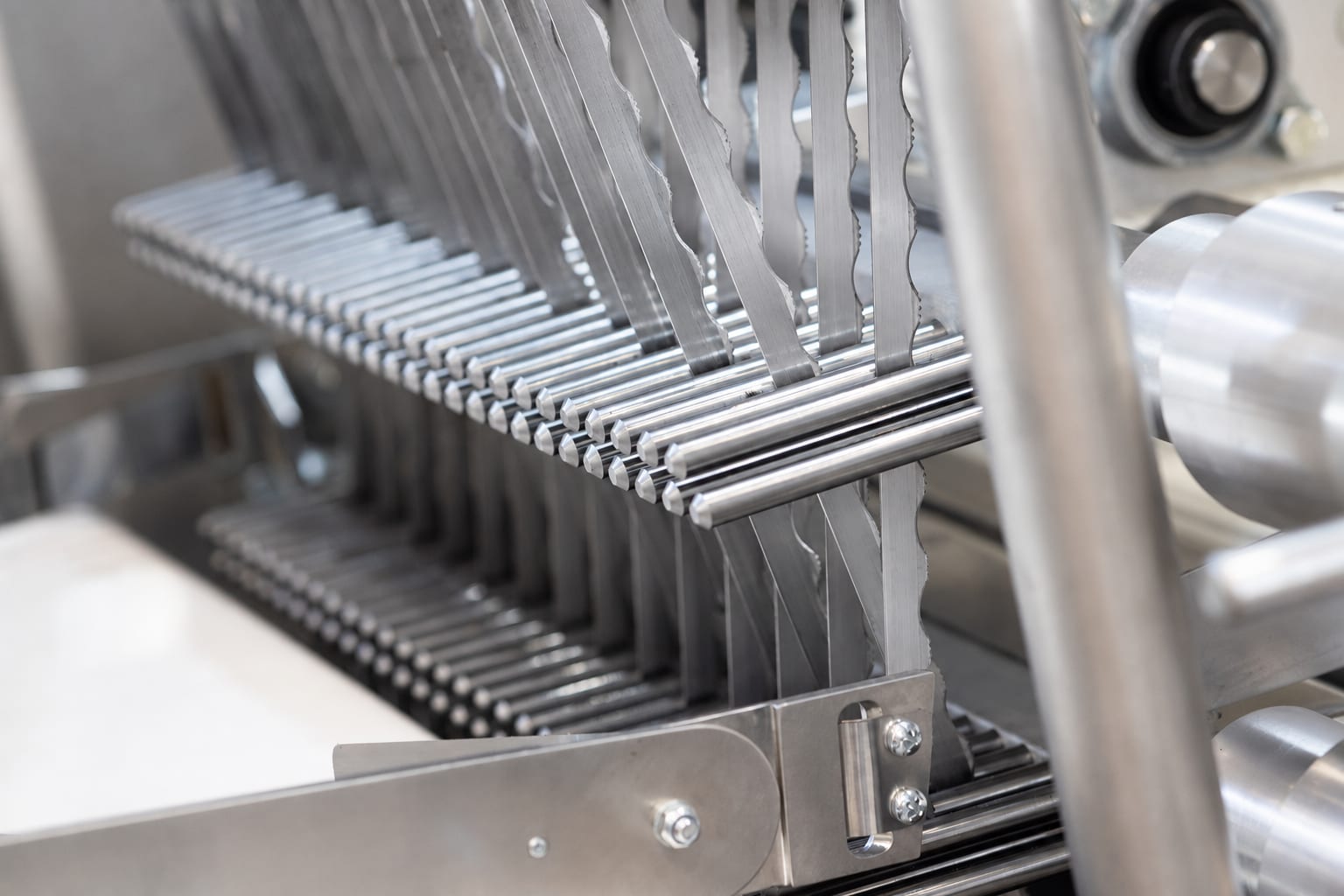
Industrial slicing equipment designed for demanding products incorporates features that help manage the challenges posed by gluten-free breads.
Adequate motor power. Dense or sticky crumb increases resistance as the blade passes through the loaf. Sufficient motor power maintains blade speed under load, reducing the tendency for the blade to drag or compress the product. For example, the Masterslicer 2R, designed for particularly demanding products including gluten-free bread, is equipped with a 7.5kW motor to handle challenging applications.
Blade maintenance systems. Friction between the blade and sticky or dense crumb can lead to buildup, which reduces cut quality and increases the force required to slice. Blade oiling systems help manage this by reducing friction. The Masterslicer 2R includes a smart blade oiling system as part of its design for extra-demanding breads like hard-crust, thick rye, and gluten-free products.
Blade length and geometry. Longer blades allow for a smoother cutting action with more teeth engaged in the product at any given moment. The Masterslicer 2R has a blade length of 184 inches, contributing to its capability with demanding products.
Adjustability. The ability to adjust slicing speed, feed rate, and blade tension allows operators to tune the machine to the specific characteristics of their gluten-free formulation. What works for one product may not be optimal for another.
It is important to note that equipment capability does not guarantee perfect results across all formulations. The Masterslicer 2R is suitable for particularly demanding products, but slicing performance still depends on the interaction between equipment settings, product characteristics, and maintenance practices. Heavy-duty equipment provides the foundation for reliable slicing of challenging breads, but it is not a universal solution independent of product and process variables.
Not all gluten-free breads require heavy-duty slicing equipment. Some formulations slice well on standard industrial machines. The key is to match equipment capability to your specific product's demands.
Evaluate your product's characteristics. Before selecting equipment, assess your gluten-free bread honestly. Is the crumb cohesive or friable? Is it sticky or dry? How hard is the crust? How consistent is the texture from batch to batch? These factors determine the level of equipment robustness you need.
Consider motor power relative to product density and volume. If your gluten-free bread is dense and you are running continuous production, motor power becomes more critical. A motor that is adequate for soft sandwich bread may struggle with a heavy gluten-free rye-style loaf over an extended production run.
Assess whether blade oiling or cleaning systems are necessary. If your formulation tends to produce a sticky crumb or if you experience blade buildup during test slicing, a blade oiling system or easy access for cleaning becomes important. This is a common requirement for many gluten-free products.
Verify that the slicer is rated for demanding products. Equipment manufacturers often specify whether a model is designed for standard breads or for more challenging applications. For gluten-free breads that fall into the demanding category, look for machines explicitly rated for hard-crust, dense, or specialty breads.
As a practical starting point: a large, heavy gluten-free loaf typically needs the Masterslicer 2R, since its higher motor power and blade support handle the extra resistance consistently. A smaller gluten-free loaf presents less resistance to the blade, so a versatile slicer like the Masterslicer 1W or Masterslicer E, equipped with blade oiling, is usually sufficient. The exact line depends on your specific formulation, so treat this as a starting point for a conversation rather than a strict rule.
Blade sharpness and maintenance matter regardless of equipment quality. Even the most robust slicer will produce poor results with dull blades. Regular blade replacement is essential, and this is particularly true for demanding products like gluten-free bread, where crumb characteristics can accelerate blade wear.
Reliable slicing of gluten-free bread is achievable with appropriate equipment matched to your specific formulation. Success depends on understanding your product's particular challenges and selecting equipment with the capability to address them.
If possible, test your actual product on candidate equipment before making a purchase decision. Observing how your specific gluten-free formulation behaves during slicing provides more useful information than general category recommendations. Pay attention to slice consistency, crumb integrity, and whether the machine maintains performance over an extended run.
Consulting with equipment suppliers who have experience with demanding breads is also valuable. Ipeka Automation has manufactured Masterslicer bread slicers since 1990, over 35 years of experience, with machines in use in 57 countries. This background includes working with bakeries producing a wide range of challenging products, including gluten-free breads with varying formulations and characteristics.
The technical challenges posed by gluten-free bread are real, but they are manageable with the right combination of equipment capability, process tuning, and maintenance practices. Understanding why gluten-free products are classified as demanding helps you make informed decisions about equipment selection and set realistic expectations for your production line.
Contact Ipeka to discuss your specific gluten-free bread formulation and slicing requirements. Our team can help you evaluate whether standard or heavy-duty slicing equipment is appropriate for your product.
Gluten-free bread lacks the elastic protein network that gives wheat bread its cohesion and mechanical strength. Without this network, gluten-free breads can be more prone to crumbling, compression during cutting, and inconsistent texture. The severity of these challenges depends heavily on the specific formulation, including moisture content, binding agents, and crumb structure.
No. Some gluten-free formulations slice well on standard industrial equipment, while others are particularly demanding and benefit from heavy-duty machines with features like higher motor power, robust construction, and blade oiling systems. The appropriate equipment depends on your specific product's characteristics, including density, moisture content, and crumb cohesion.
Key features include robust construction to maintain blade alignment, adequate motor power to maintain blade speed through dense or sticky crumb, blade maintenance systems like automatic oiling to reduce friction and buildup, and sufficient blade length for clean cuts. Adjustability in slicing speed and feed rate also helps optimize performance for specific formulations.
Assess characteristics like crumb cohesion (does it crumble easily?), stickiness, crust hardness, moisture content, and texture consistency. High-hydration breads, products with very hard crusts, dense rye-style formulations, and breads with open, fragile crumb structures tend to be more challenging. Testing your actual product on industrial equipment before purchase provides the most reliable information.
This article is based on Ipeka's knowledge base, built up over years of hands-on engineering experience. Every article is reviewed and edited by Ipeka's own experts. Claude (Anthropic) was used to help produce clear, high-quality English text.
