A good bread slicer can only perform as well as the product flow feeding it.
When planning an industrial bread slicing line, a surprising amount of attention is naturally given to the slicer itself: capacity, slice thickness, blade configuration, bread dimensions and the equipment that comes after the slicer. But the conveyor arrangement between the cooling system and the slicer can be just as important.
For an Ipeka Masterslicer, the ideal infeed arrangement depends on several factors, but one of the first questions is very simple:
How does the bread arrive from the cooling track to the slicer proximity – wide side leading or narrow side leading?
If the loaves are already travelling wide side leading, a small low-friction accumulation conveyor may be all that is needed. If they arrive narrow side leading, a paddle feeder can both change the direction of feeding and accurately control the flow into the slicer.
And for a completely manual line, neither may be necessary.
Let's look at the different options and why the way you feed a band blade slicer matters in the first place.
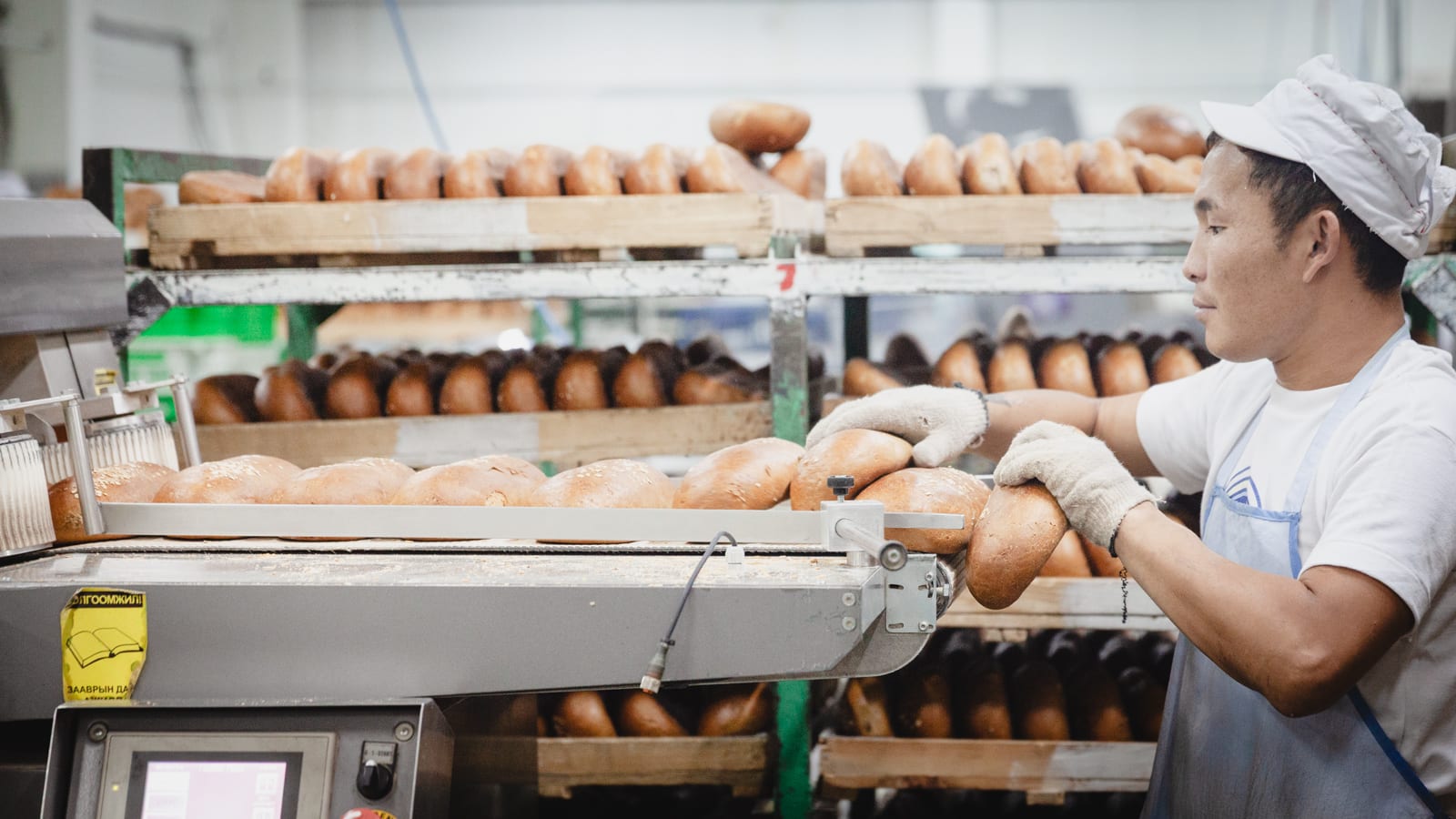
A band blade bread slicer such as the Ipeka Masterslicer works best with a continuous queue of loaves on its infeed conveyor.
The slicing principle relies on back pressure. The loaves travel towards the slicing section in contact with each other, effectively pushing the preceding loaves through the moving band blades. This contributes to stable operation and the best possible slicing quality.
However, there is an important distinction between maintaining back pressure and simply pushing harder.
Continuous product flow does not mean excessive product pressure.
This is particularly important with soft tin bread and toast bread. An upstream conveyor that continues pushing against a stopped queue of loaves can compress or deform the product. The objective is therefore to create a controlled queue with enough accumulation to keep the slicer supplied, but without unnecessary pressure on the bread.
This is where the design of the infeed system becomes important.
The simplest arrangement is manual feeding.
In a fully manual slicing line, one operator places whole loaves onto the Masterslicer infeed conveyor. Another operator typically receives the sliced loaves at the outfeed and transfers them to the next process, which could be manual bagging or another packaging operation.
In this configuration, the operator feeding the slicer should try to maintain a continuous queue of bread on the infeed conveyor. The slicer can be equipped with an additional 2-meter infeed conveyor or a 1-meter free-roller infeed section to provide more space for buffering and make manual feeding easier.
The Masterslicer has photocells at both the infeed and outfeed. In a fully manual installation, the infeed photocell is normally disabled from the touchscreen.
Manual feeding is therefore a simple and practical solution when production capacity and the overall level of line automation do not justify an automatic infeed system.
When the Masterslicer is connected directly to an automatic production line, the first question is the orientation of the bread.
Suppose the loaves leave the cooling spiral wide side leading, and this is also the orientation in which they should enter the slicer.
In this case, there is no need to reorient the products. The main requirement is to create a controlled buffer before the slicer.
A typical arrangement would be:
Cooling spiral → accumulation conveyor → Masterslicer
For this application, Ipeka's preferred solution is a roller-top belt accumulation conveyor.
A roller-top belt has freely rotating rollers on its surface. When the queue of bread stops moving forward, the belt can continue moving underneath the products while the rollers reduce the friction between the moving belt and the stationary loaves.
This allows a small number of loaves to accumulate without the conveyor continuously forcing them against each other.
A conveyor belt with a very low-friction or slippery surface can also be used, but a roller-top belt is generally the preferred solution.
The flow of bread from a cooling spiral is not necessarily perfectly synchronized with the instantaneous demand of the slicer.
There may be variations in spacing between loaves or short interruptions in the incoming product flow. Likewise, the slicer may stop temporarily because the downstream equipment is not ready to receive another loaf.
A small accumulation section decouples these variations.
Its purpose is not to create a large storage area. It simply provides enough buffering to help keep the Masterslicer infeed consistently supplied.
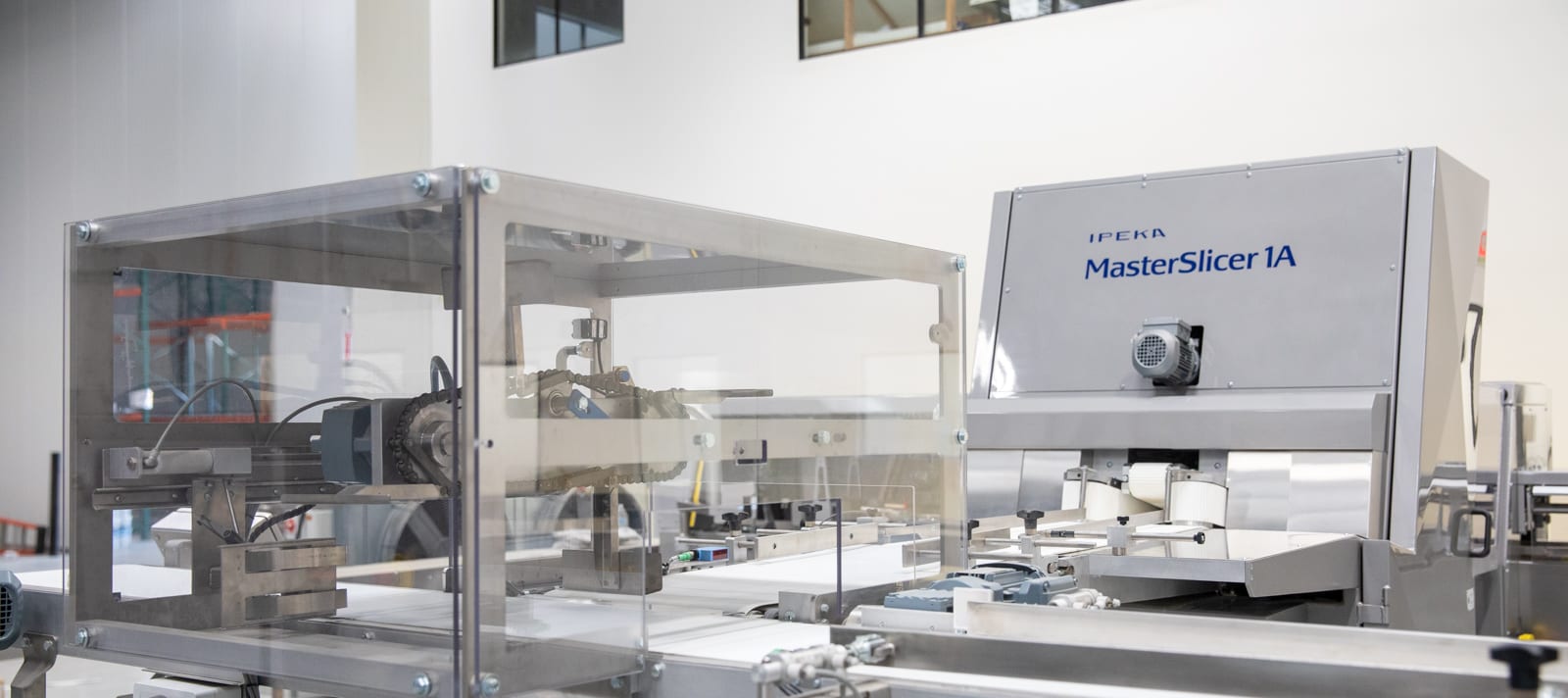
The situation changes when the bread leaves the cooling system narrow side leading.
The Masterslicer needs the loaves to be presented in the correct orientation for slicing, so simply adding an accumulation conveyor is no longer sufficient.
For this type of installation, Ipeka can use a paddle feeder arrangement.
A typical layout is:
Cooling spiral → cross conveyor → paddle feeder → short infeed conveyor → Masterslicer
The loaves travel along the cross conveyor narrow side leading. A paddle driven by circulating chains transfers a loaf sideways from this conveyor onto a short conveyor leading to the Masterslicer.
After this transfer, the loaf is travelling wide side leading towards the slicer.
The paddle feeder therefore performs two important functions.
First, it changes the direction in which the bread is fed to the Masterslicer.
Second, it acts as a controlled feeding device. Rather than simply allowing bread to flow towards the slicer, the paddle mechanism transfers loaves according to the demand of the Masterslicer and can therefore fill its infeed conveyor accurately.
This makes the paddle feeder particularly useful when the orientation coming from the cooling system does not match the orientation required at the slicer.
There is another useful feature of the paddle feeder arrangement that is easy to overlook when designing a production line: the bread does not necessarily have to go to the slicer at all.
During normal production, the paddle transfers each loaf from the cross conveyor towards the Masterslicer.
But what happens if the slicer stops?
Perhaps there is a temporary fault, maintenance is required, or the downstream packaging equipment is unavailable. At the same time, there may still be bread coming from the cooling spiral that needs to be removed from the line.
With the paddle feeder arrangement, the paddle can simply stop transferring bread to the Masterslicer.
The loaves then remain on the cross conveyor and continue straight past the slicer.
They can, for example, be discharged into a collection box or transferred onto an additional conveyor.
This creates a simple slicer bypass.
Depending on the design of the complete bakery line, this can be an important advantage. A temporary slicer stop does not necessarily mean that every upstream process must stop immediately.
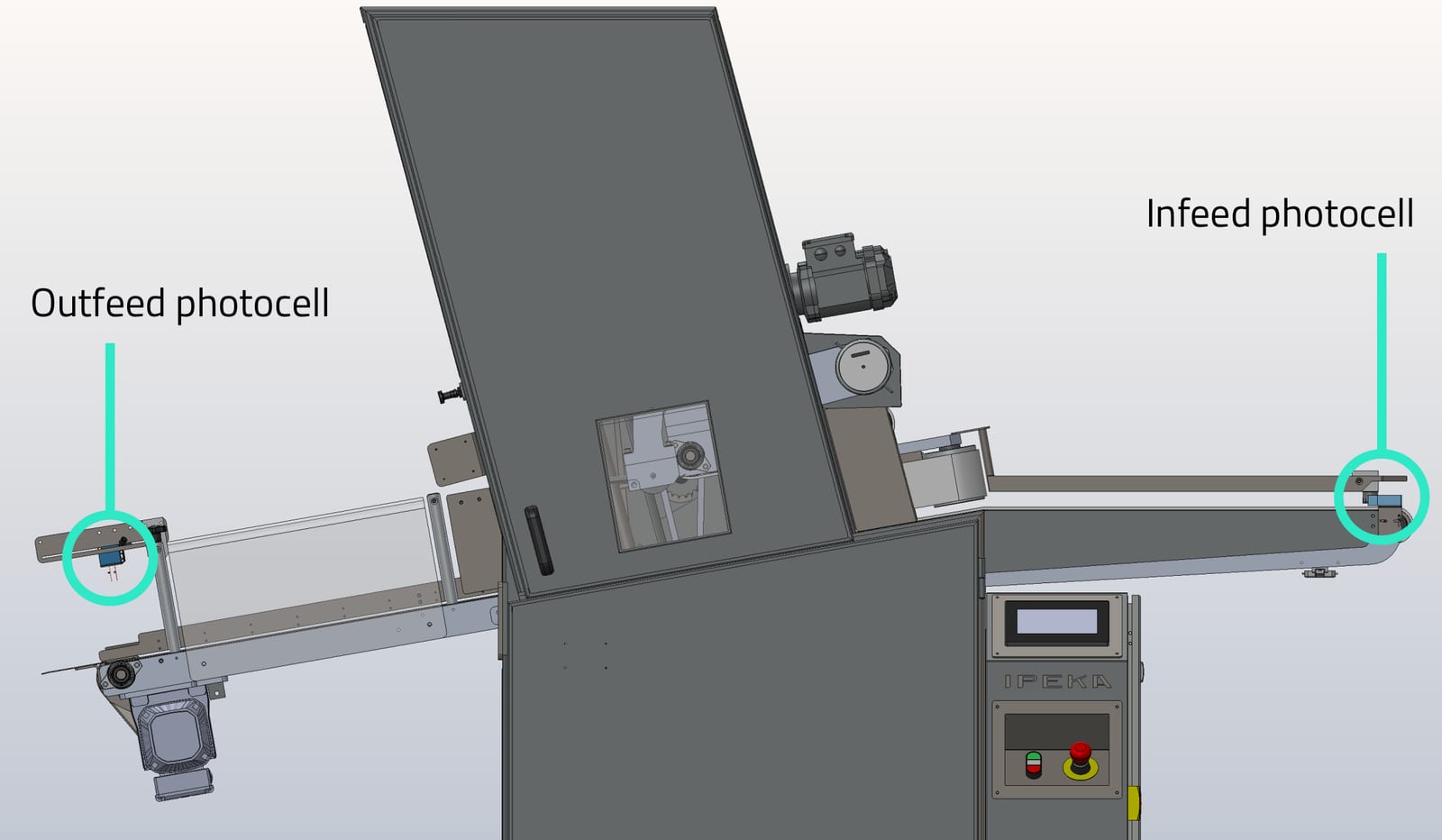
When a Masterslicer is integrated into an automatic line, its infeed photocell is normally enabled. (In manual installations, as mentioned earlier, the infeed photocell is typically disabled.)
The infeed photocell in automatic mode works differently from the outfeed photocell.
The outfeed photocell prevents the slicer conveyors from feeding more bread when a sliced loaf is waiting at the discharge, for example when the bread is bagged manually.
When the slicer is connected to an automatic packaging machine, such as the Ipeka Loafmaster, the outfeed photocell is not used. Instead, a synchronized flight-bar conveyor transfers the sliced loaves from the slicer to the packaging machine.
The infeed photocell helps prevent the slicer from emptying its own infeed conveyor when there is not enough bread arriving from upstream.
When bread is present at the infeed photocell, the slicer conveyors can run. If bread is no longer detected, the conveyors stop after a predefined delay.
The delays for both photocells can be adjusted. This allows the behaviour to be optimized according to factors such as line speed, product spacing and the characteristics of the bread.
The result is a relatively simple principle: run when there is bread available and space for sliced bread at the discharge.
Mechanical product handling is only one part of a successful line integration. The slicer and upstream equipment also need to communicate.
The required handshake signals can be agreed between Ipeka and the supplier responsible for the cooling spiral and conveyor system.
For example, the upstream system may need information about whether the Masterslicer is running, stopped or ready to receive product. The exact interface depends on the design and control architecture of the complete line.
There is also one technical difference worth noting when integrating different Masterslicer models.
Standard Masterslicer models use an Omron PLC. The Masterslicer 1A, however, includes servo-driven automatic slice-thickness adjustment and therefore uses a Yaskawa Motion Controller to control its functions.
From the customer's perspective, the objective remains the same: the slicer and upstream product-handling system should operate together as one coordinated line.
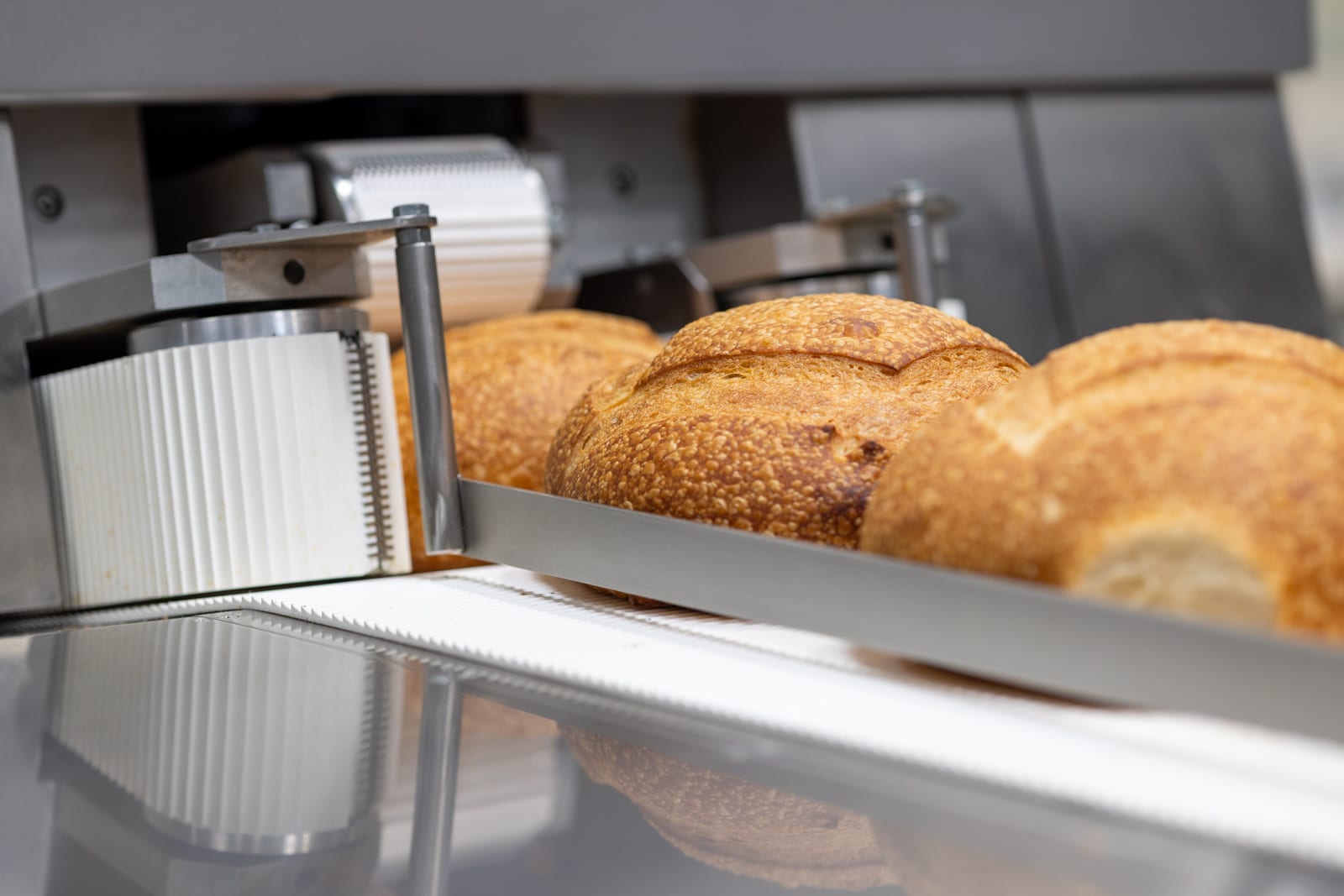
The basic selection can often be made surprisingly quickly.
| Production situation | Typical solution |
|---|---|
| Manual slicing line | Manual feeding |
| Automatic line, bread arrives wide side leading | Accumulation conveyor |
| Automatic line, bread arrives narrow side leading | Paddle feeder |
| Soft bread requiring accumulation | Roller-top belt preferred |
| Slicer bypass is required | Paddle feeder with cross conveyor |
These should be considered general principles rather than absolute rules.
Bread dimensions and shape, product softness, required capacity, cooling spiral configuration, available floor space and downstream packaging equipment can all affect the final solution.
This is why the infeed should ideally be considered when designing the slicing line rather than after the slicer has already been selected and positioned.
A band blade slicer works best when the loaves form a continuous queue on the infeed conveyor. The loaves support and push each other through the slicing section, creating the back pressure needed for stable slicing. Large gaps between individual loaves can reduce the consistency of the feeding process and affect slicing performance.
If the bread already arrives wide side leading, an accumulation conveyor is usually the preferred solution. Ipeka particularly recommends a roller-top belt conveyor, as the freely rotating rollers allow bread to accumulate while minimizing pressure on the products. This is especially beneficial for soft bread that could otherwise become compressed or deformed.
A paddle feeder is a good solution when loaves arrive from the cooling line narrow side leading but need to enter the slicer wide side leading. The paddle feeder transfers the loaves sideways from a cross conveyor onto the slicer infeed and simultaneously controls the rate at which the Masterslicer is supplied with bread.
Yes. With a suitable cross conveyor and paddle feeder arrangement, the paddle feeder can stop transferring bread to the Masterslicer while the loaves continue travelling straight ahead on the cross conveyor. The bread can then be collected in a container or transferred to another conveyor. This allows bread to be removed from the upstream line even when the slicer is temporarily unavailable.
This article is based on Ipeka's knowledge base, built up over years of hands-on engineering experience. Every article is reviewed and edited by Ipeka's own experts. Claude (Anthropic) was used to help produce clear, high-quality English text.
